Tuesday, February 9, 2021

A Christmas Carol (1951), Starring Alastair Sim: Review by William Mortensen Vaughan

 Title:  A Christmas Carol

Adaptation:  Starring Alastair Sim as Ebenezer Scrooge

Dates and Places of Earliest Release:  
(WWW, DD MMM YYYY Country)
 
My Rating:  ** (Substandard - Black and White/Colorized)

Format Reviewed: 
live-action film, on DVD
 
Runtime:  86 minutes
 
Availability:  
As of February 9, 2021, copies of this film, on DVD, are available, online, for less than $10 U.S. Dollars.

Is this adaptation reverent? 
Yes. (See below.)

Does this adaptation mention "God" or "Christ"?
Yes. (See below.)
 
Does this adaptation include the phrase "God bless us...?" 
Yes, Bob Cratchit (Mervyn John's) family toast, and say, "God bless us!" and Tiny Tim says, "God bless us, everyone!"  Furthermore, the narrator quotes this quote by Tiny Tim, at the end of the film.

What does my wife think of
this adaptation?
She thinks it's "interesting."

Where and when does this adaptation take place?
Victorian England
 
What language and/or dialects are used?  
British English

How closely does this adaptation follow the original novel, by Charles Dickens?

This adaptation follows the original novel fairly well, with some exceptions, and several additions:

The film begins with a hand taking a copy of the book titled A Christmas Carol, off a shelve full of other novels by Charles Dickens.  A Narrator (Peter Bull) quotes the initial lines about Jacob Marley (Michael Hordern) being dead, as the initial credits appear, on what appear to be sheets of paper or pages of a book.

The opening scene, after the opening credits, is at the Exchange, where Scrooge engages in a conversation about Christmas with other businessmen.  A man named Samuel Wilkins begs him for more time to pay off his loan, on the steps of the Exchange.

After showing Mr. Wilkins no mercy, Scrooge walks to his office, inside of which two gentlemen are waiting to ask him for a donation.  

Fred (Brian Worth) arrives after the gentlemen leave without a donation from Mr. Scrooge.  Mr. Scrooge shows him the door as well.

Then there is an scene featuring Tiny Tim (Glyn Dearman) and his mother (Hermione Baddeley), window shopping.

Meanwhile, back at Scrooge's office, Scrooge tells Bob Cratchit (Mervyn Johns) to take the next day, Christmas, off.  Then he leaves Bob to close shop.
 
Scrooge goes to a tavern after work, but seems unfamiliar with it, unlike the tavern Dickens describes, in his novel, as Scrooge's "usual, melancholy tavern," because, when Scrooge asks for more bread, the waiter changes his mind by informing him that bread costs extra.


When Scrooge arrives at the building where he lives, Scrooge hears someone calling his name.  Then Jacob's face appears in the doorknocker, with his eyes closed; then Jacob opens his eyes, startling Scrooge.  Later, Jacob Marley appears to Scrooge in person, and tells Scrooge about the three Ghosts that will visit him.  He tells Scrooge the first Ghost will arrive at one-o'-clock.

He also shows him other ghosts outside Scrooge's window, lamenting that they can no longer help the poor.  Then Marley takes his leave of Scrooge.

Scrooge slams the window shut, and literally runs to bed, where he pulls all of the bed curtains closed, and hides under his bed covers.

The bell tolls one, and the Ghost of Christmas Past (Michael Dolan) appears, taking Scrooge to see his school, and his sister, Fan. The scene of her death is added, as she begs Scrooge, with her dying breath, to take of her son.

Scrooge revisits the Fezziwig Christmas Ball, and his fiancee, named Alice (Rona Anderson), instead of Belle, in this adaptation.

Also added are scenes in which a new character, Mr. Jorkin (Jack Warner), offers Mr. Fezziwig (Roddy Hughes) a business proposition, which Mr. Fezziwig refuses.  However, Mr. Jorkin is able to persuade young Scrooge (Geoge Cole) to leave Mr. Fezziwig's company, and take a job at his company, where he becomes friends with Jacob Marley.

Mr. Jorkin is caught embezzling, but the scandal threatens to devalue the company's stock, so Scrooge and Marley offer to pay off the company's debt, on the condition that they are allowed to buy 51% of the stock in the company, effectively making them the new owners.

They take over Mr. Fezziwig's company, as well, letting one young employee keep his job, but for four Shillings per week, instead of the five Mr. Fezziwig was paying him.  

Mrs. Dilber (Kathleen Harrison) goes to Scrooge's office to ask him to visit Marley in Marley's final moments.  Scrooge does so, after work.  The undertaker (Ernest Thesiger) is already there, waiting for Marley to die.  Marley tries to tell Scrooge that they were wrong, and to save himself, but Scrooge doesn't understand.

When Marley dies, Scrooge is only too happy to inherit all of Marley's belongings.

The Ghost of Christmas Present (Francis de Wolff) shows Scrooge the Cratchit residence, where Bob proposes a toast to Mr. Scrooge, and his family says, "God bless us!"  Tiny Tim says, "God bless us, everyone!" 

Instead of showing Alice with a husband and children, the Ghost shows her in what appears to be a homeless shelter, comforting the poor.

The Ghost also shows Scrooge Fred's Christmas Party, where Fred proposes a toast to Mr. Scrooge, although two of the women there indicate that they despise Scrooge.

Mr. Tupper [sic] (Richard Pearson) flirts with Miss Flora (Eleanor Summerfield).

No games are played, but Fred and his guests dance a waltz.

The Ghost of Christmas Present shows Scrooge Ignorance and Want, in the form of children hiding under his robe.  Then he leaves Scrooge running down the street...

...and into the Ghost of Christmas Yet to Come (Czeslaw Konarski).    

This ghost shows Scrooge the Cratchits mourning for Tiny Tim; the scene with Mrs. Dilber, another woman, and the undertaker, at Old Joe (Miles Malleson's) pawn shop, which, in this adaptation, is filled with children working among his marketable rubbish; and the two businessmen at the Exchange mentioning Scrooge's death, without naming him.  When Scrooge asks who they're talking about, the Ghost shows him his tombstone.

Begging for mercy, Scrooge wakes up to find himself in his own bed on Christmas morning.  He asks his charwoman, Mrs. Dilber what day it is, and gives her a Guinea for a Christmas present.  He also promises to raise her wages from two Shillings a week to ten.  Then he sends her away to celebrate Christmas.

Then Scrooge looks outside his bedroom window, and sends a boy to get the prize turkey, which he sends to Bob Cratchit's house.

Then Scrooge goes to Christmas dinner at Fred's.

The next day, Scrooge catches Bob coming in late to work.  Instead of punishing him, he raises Bob's salary.  After promising to discuss this over a hot bowl of punch, he sends Bob out to buy some more coal.  
 
Is this adaptation a prequel or a sequel?  No.

Is this adaptation supernatural? 
Yes, this film features ghosts and time travel.

Is this adaptation "framed"?
  
Yes, this adaptation is framed by a Narrator, whose voice is heard at the beginning and end of the film.

Is this adaptation a musical?  No.
 
What songs and/or dances are included?  
Musical score by Richard Addinsell... There are several musical numbers and dances included in this adaptation, including "Barbara Allen," sung by Fred and his guests.

How attractive and effective is the visual art?  
The set, wardrobe, and art are adequate.

How creative and intense are the transitions, especially when "the Scrooge" is taken from one time and/or place to another?
The transitions are adequate; an hourglass floats and/or spins through a windy tunnel to show time travel.
 
What aerial and/or nap-of-the-earth footage is included?  N/A
 
What use is made of background extras?  
Adequate use is made of background extras; for example, there seem to be plenty of people at Fred's party.

What is the most remarkable thing about this adaptation? 
The most remarkable thing about this adaptation is, perhaps, the addition of Mr. Jorkin, who hires Scrooge and introduces him to Jacob Marley, and the scenes which develop Jacob and Marley's characters and their relationship with each other over the years.
 
What bonus material is included on the tape or DVD? 
The "Ultimate Collector's Edition" includes two discs, which are not labeled Disc 1/A and 2/B, or anything like that, so I'll call them "Colorized" and "Black and White."

The "Colorized" Disc contains:
 
  1. A colorized version of the original black and white film
  2. A copy of the black and white film "Scrooge" (1935), starring Seymour Hicks
  3. Subtitles in English or Spanish
  4. An audio track in narrative English for the blind
  5. "The Spirit of Christmas Past:  George Cole Remembers Alastair Sim"
  6. "Richard Gordon Remembers George Minter and Renown Pictures"
  7. "Charles Dickens:  His Life and Times"
  8. "Before and After Restoration"
  9. "Photo Gallery"
 
The "Black and White" Disc contains:
  1. "A Christmas Carol" in black and white, with 3 x 4 resolution    
  2. "A Christmas Carol" in black and white, with 9 x 16 resolution
  3. An audio commentary by Marcus Hearn and George Cole (young Ebenezer Scrooge)
  4. Cast Bios:
  •            Alastair Sim
  •            Kathleen Harrison
  •            Jack Warner
  •            Bryan D. Hurst
  •            Mervyn Johns
  •            Hermione Baddeley
  •            George Cole
Review by William Mortensen Vaughan

A Christmas Carol (1994), Featuring the Northern Ballet: Review by William Mortensen Vaughan

 Title:  A Christmas Carol

Adaptation:  Starring Jeremy Kerridge as  Ebenezer Scrooge, and featuring the Northern Ballet

Dates and Places of Earliest Release:  
THU, 8 DEC 1994 U.S.A
(NOTE:  The film indicates that it was produced in 1992.)
 
My Rating:  *** (Viewer Discretion Advised)

Format Reviewed: 
live-action film, on DVD
 
Runtime:  131 minutes
 
Availability:  
As of February 9, 2021, copies of this film, on DVD, are available, online, for approximately $35 U.S. Dollars.

Is this adaptation reverent? 
Yes, this adaptation is reverent; it includes the hymn "God Rest Ye, Merry Gentlemen!"

Does this adaptation mention "God" or "Christ"?
Yes. (See above.)
 
Does this adaptation include the phrase "God bless us...?"  No.

What does my wife think of
this adaptation?
She refuses to watch it.

Where and when does this adaptation take place?
Victorian England
 
What language and/or dialects are used?  
British English

How closely does this adaptation follow the original novel, by Charles Dickens?
This adaptation follows the original novel fairly well, but with obvious changes:

The opening scene is Marley's funeral procession.

Instead of two portly gentlemen entering Scrooge's office to ask him for a donation, a crowd of picketers appear outside his office, where Bob Cratchit joins them in asking for "Christmas Comfort for the Poor," and for people to "Feed the Hungry."

Fred apparently brings a woman (presumably, his wife) to visit Scrooge at his office.

An odd musical number is inserted, in which a line of dirty children, dressed in rags, file past a stern-looking man, while a variation of the song "Four Pence a Day" is heard in the background.

Instead of sliding on his feet across ice, Bob Cratchit (Rocco Vitalia) slides on his bottom, down a slippery slide used to lower burlap bags full of some product from an upper level to a lower level, on the stage.

Fred's residence is never shown.  Bob plays Blind Man's Buff with his family after Tiny Tim's death.

Only four children appear at Bob's residence.

When the Ghost of Christmas Yet to Come shows Scrooge his bedroom in the future, after his death, four hags fight over his belongings.

On Christmas Day, Scrooge throws a block party in front of his office, to which Fred, Fred's wife, and Bob come to celebrate.
 
The grand finale, at Scrooge's office, features an encore appearance by the Ghosts of Christmas Past, Present, and Yet to Come.

Is this adaptation a prequel or a sequel?  No.

Is this adaptation supernatural? 
Yes, this film features ghosts and time travel.

Is this adaptation "framed"?
  No.

Is this adaptation a musical?  Yes.
 
What songs and/or dances are included?  
There is a unique version of "Four Pence a Day," and various other songs, including one which contains the phrase "Marley is dead!"

How attractive and effective is the visual art?  
The set, wardrobe, and art are excellent. Although the action obviously takes place on a stage, it makes me feel as if I'm in a fantastic version of London, England, during Queen Victoria's reign.

How creative and intense are the transitions, especially when "the Scrooge" is taken from one time and/or place to another?
The transitions are excellent; they do not use special film effects which detract from the play, although different camera angles and zooming in and out help keep the viewer's interest.
 
What aerial and/or nap-of-the-earth footage is included?  N/A  
 
What use is made of background extras?  
Excellent use is made of background extras, most of whom seem to be healthy, young dancers and acrobats.

What is the most remarkable thing about this adaptation? 
The most remarkable thing about this adaptation is, perhaps, the inclusion of the song "Four Pence a Day."
 
What bonus material is included on the tape or DVD? 
Scene selection and subtitles in English, French, German, and Spanish are available on the DVD.  An excellent program, in the form of a twenty-page booklet is included with the disc, in the jewel case.

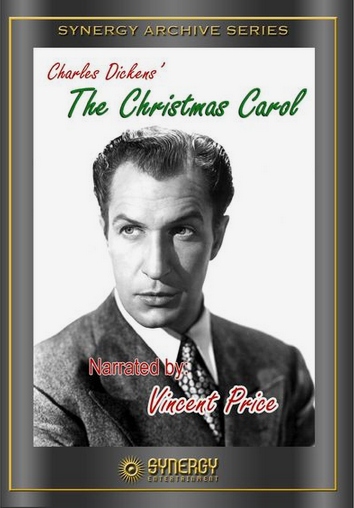
The Christmas Carol (1949), Narrated by Vincent Price: Review by William Mortensen Vaughan

 Title:  The Christmas Carol

Adaptation:  Starring Vincent Price as the Narrator, and Taylor Holmes as  Ebenezer Scrooge

Dates and Places of Earliest Release:  
SUN, 25 DEC 1945 U.S.A.
 
My Rating:  ** (Substandard - Black and White/Low Budget)

Format Reviewed: 
live-action film, on DVD
 
Runtime:  25 minutes
 
Availability:  
As of February 9, 2021, copies of this film, on DVD/VHS, are available, online, for approximately $10 U.S. Dollars.

Is this adaptation reverent? 
Yes, it includes enough of the hymn "God Rest Ye, Merry Gentlemen" to mention Baby Jesus' birth.

Does this adaptation mention "God" or "Christ"?
(Yes. See above and below.)
 
Does this adaptation include the phrase "God bless us...?" 
Yes, Vincent Price quotes Tiny Tim as saying "God bless us, everyone!"

What does my wife think of
this adaptation?
She thinks it is one of the worst adaptations of A Christmas Carol.

Where and when does this adaptation take place?
Victorian England
 
What language and/or dialects are used?  
American English

How closely does this adaptation follow the original novel, by Charles Dickens?
This adaptation follows the original novel fairly well.  Ebeneezer [sic] receives a visit from his nephew Fred, in his office Christmas Eve.  Fred refers to his wife as "Caroline," although, in the original novel, Caroline is the poor woman who was relieved when her husband informed her that Scrooge was dead.  No portly gentlemen arrive to collect donations.  

After releasing Bob Cratchit, as Scrooge departs from his office, carolers are heard singing "The First Noel," but none of them appear.  Later, when the Ghost of Christmas Present shows Scrooge himself as a schoolboy, Scrooge says he regrets not giving
anything to a boy who was singing Christmas carols that day, presumably referring to one of the carolers.

There is no sliding on ice, but the Narrator does mention Scrooge having dinner at his "usual, melancholy tavern."

The Ghost of Jacob Marley appears to Scrooge in his private quarters, but does not show him the other ghosts in chains.

Then the Ghost of Christmas Past appears as an old man wrapped in what appear to be bed sheets.  He shows Scrooge himself as a schoolboy, but not the arrival of Fan; nor is she mentioned.  Neither is Mr. Fezziwig mentioned, but the Ghost asks Scrooge if he should show him the time his fiancée broke off their engagement to be married.

The Ghost of Christmas Present looks like a young man in a robe.  He shows Scrooge the Cratchits celebrating Christmas in their home.  Tiny Tim says, "God bless us, everyone!"  Then, after a brief conversation between Scrooge and the Ghost of Christmas Present, thunder claps and the Ghost of Christmas Yet to Come appears.  No mention of Fred's Christmas party is made.

The Ghost of Christmas Future looks like an old man in black bed sheets.  He shows the Cratchits mourning for Tiny Tim.  Then he shows Scrooge four businessmen talking about his demise.  Finally, he shows Scrooge his tombstone.

Scrooge wakes up in his private quarters on Christmas morning.  He has a conversation with a boy outside his window, but does not send him to fetch anything.  Instead, he goes out on his own.

Fred and Scrooge visit Bob on Christmas Day, bringing them a large bird to cook, and other presents.  Scrooge mentions having met a surgeon at church that day, to whom he promises to take Tiny Tim.
 
Is this adaptation a prequel or a sequel?  No.

Is this adaptation supernatural? 
Yes, this film features ghosts and time travel.

Is this adaptation "framed"?  Yes, it is framed by Vincent Price narrating it, while sitting with what appears to be a hard copy of A Christmas Carol, in the comfort of what appears to be his home.


Is this adaptation a musical?  No.
 
What songs and/or dances are included?  
Music by The Robert Mitchell Boy Choir; Edward Paul, Director... See above.

How attractive and effective is the visual art?  
The wardrobe and set are barely adequate.  All scenes are indoors.

How creative and intense are the transitions, especially when "the Scrooge" is taken from one time and/or place to another?
The transitions are poorly done; they consist of the Ghosts motioning for Scrooge to follow them in dark rooms, and pointing; then the camera cuts to another scene or shot.  Outdoor scenes are noticeably absent.
 
What aerial and/or nap-of-the-earth footage is included?  N/A
 
What use is made of background extras?  
Inadequate use is made of background extras, which makes this film seem low budget.

What is the most remarkable thing about this adaptation? 
The most remarkable thing about this adaptation is, perhaps, the narration by Vincent Price.  His portrait is on the cover of the DVD, and on the DVD itself.  He gets top billing, and rightly so, in my opinion.  I would rather watch him read and/or narrate the entire book than endure the poor footage sprinkled between the scenes of him narrating this adaptation. It should have been filmed with him alone, and titled A Vincent Price Christmas Carol.
 
What bonus material is included on the tape or DVD? 
No bonus material is included on this DVD. When I put it in my BluRay player, it begins playing automatically, and the "Menu" button on my remote control doesn't work. Pressing "Stop" causes a message to appear which informs me that I can press "Play" to continue playing the video from the current location, or "Stop," then "Play," to start playing the video from the beginning. Pressing "Stop" causes the BluRay player's splash screen to appear.

Review by William Mortensen Vaughan

Monday, February 8, 2021

Quiz 4 on An American Christmas Carol (1979), Starring Henry Winkler

 1.  Where was the company located, where "the Scrooge" moved when he left the shop where he worked as a child, in this adaptation of A Christmas Carol?


 2.  What are the first and last names of "the Belle," in this adaptation of A Christmas Carol?


 3.  What are the first and last names of "the Mrs. Cratchit," in this adaptation of A Christmas Carol?


 4.  In this adaptation of A Christmas Carol, "the Scrooge" and "the Belle" dance together as if they were imitating birds. What were these kinds of dances called, and when were they popular?


 5.  In this adaptation of A Christmas Carol, "the Scrooge" and "the Belle" dance together as if they were imitating birds. The song being played as they dance this way sounds like a popular song viewers are more likely to have heard; what song is that, and when was it first released?


 6.  What was the name of "the Scrooge's" employee, other than "the Cratchit," in this adaptation of A Christmas Carol?


 7.  What was being waged, when "the Scrooge" returned to his home town, in this adaptation of A Christmas Carol?


 8.  How much money does "the Belle" try to raise, by selling Liberty Bonds, in this adaptation of A Christmas Carol?


 9.  How much money does "the Scrooge" use to purchase Liberty Bonds, in this adaptation of A Christmas Carol?


10.  How much money does "the Belle" try to raise, by selling Liberty Bonds, before "the Scrooge" buys his, in this adaptation of A Christmas Carol?

 Answers were published on February 16, 2021.

Quiz by William Mortensen Vaughan

Answers to Quiz 3 on An American Christmas Carol (1979), Starring Henry Winkler

 1.  Of what company is Mr. Slade the President?

S & L Finance Company

 2.  What is the first name of the sister of "the Tiny Tim," in this adaptation of A Christmas Carol?

Sarah

 3.  What is the first initial and last name of the third person whose possessions "the Scrooge" repossesses, in this adaptation of A Christmas Carol?

A. Merrivale

 4.  What is the name of the store owned by the third person whose possessions "the Scrooge" repossesses, in this adaptation of A Christmas Carol?

University Shop

 5.  Initially, who does "the Scrooge" think that the Ghost of Christmas Past is, in this adaptation of A Christmas Carol?

A. Merrivale

 6.  What was the name of the person in charge of the county orphanage, when "the Scrooge" lived there, in this adaptation of A Christmas Carol?

Mrs. Tidings

 7.  What was the first and last name of the person who removed "the Scrooge" from the county orphanage, in this adaptation of A Christmas Carol?

Nathaniel Brewster

 8.  Approximately, when was "the Scrooge" removed from the county orphanage, in this adaptation of A Christmas Carol?

1890 (The primary setting for this film is Concord, New Hampshire, in 1933; when shown himself as an orphan, "the Scrooge" comments that people hadn't dressed that way for forty years, indicating that this scene took place in 1893 or prior.)

 9.  What is the name of the driver who took "the Scrooge" to the shop where he was employed as a child, in this adaptation of A Christmas Carol?

Roy

10.  What was the name of the company that employed "the Scrooge" when he left the shop where he worked as a child, in this adaptation of A Christmas Carol?

The Stapleton Furniture Company

Quiz and Answers by William Mortensen Vaughan

Rich Little's Christmas Carol (1978): Review by William Mortensen Vaughan

Title
:  Rich Little's Christmas Carol

Adaptation:  Starring Rich Little, impersonating various celebrities as the cast, including:  W.C. Fields as Ebenezer Scrooge
; Paul Lynde as Bob Cratchit; Humphrey Bogart as Fred C. Dobbs, as the Ghost of Christmas Past; Peter Falk as Columbo, as the Ghost of Christmas Present; Peter Sellers as Inspector Clouseau, as the Ghost of Christmas Yet-to-Come; Richard Nixon as Jacob Marley; Truman Capote as Tiny Tim; Groucho Marx as Fezziwig; Jean Stapleton, as Edith Bunker, as Mrs. Cratchit; Johnny Carson as Nephew Fred; Jimmy Stewart as Dick Wilkins; John Wayne, James Mason, and George Burns as Businessmen; Jack Benny as the Boy Outside the Window; and Stan Laurel and Oliver Hardy as Charity Solicitors

Dates and Places of Earliest Release:  
SUN, 17 DEC 1978 Canada
        DEC 1978 U.S.A.
 
My Rating:  *** (Viewer Discretion Advised)

Format Reviewed: 
live-action film, on DVD
 
Runtime:  50 minutes
 
Availability:  
As of January 19, 2021, two copies of this film were available online, on VHS, for approximately $190 U.S. Dollars, including tax, shipping and handling!

Is this adaptation reverent? 
This adaptation is both reverent and irreverent.  It shows Scrooge sincerely repenting and even giving up alcohol.  However, I cannot recommend it, in good faith, to general audiences, because it includes scenes in which Mr. Fezziwig sexually harasses his female employees at "A Typical Office Party."

Does this adaptation mention "God" or "Christ"?
Yes.
 
Does this adaptation include the phrase "God bless us...?" 
Yes. When Mrs. Cratchit asks someone to say "grace,"  Tiny Tim says, "God bless us, everyone!"

What does my wife think of
this adaptation?
She thinks it's one of the most uniquely entertaining adaptations of A Christmas Carol that she's ever seen, even though she doesn't usually like comedy or musicals.

Where and when does this adaptation take place?
This adaptation is a musical, comedic fantasy, in which time and place are less relevant than the jokes, songs, and impersonations.  Although the set and wardrobe usually tends to portray Victorian England, Richard Nixon and reel-to-reel tape appear as Jacob Marley and his chains, making jokes about Watergate, even though these are all Twentieth Century phenomenons.
 
What language and/or dialects are used?  
Canadian English

How closely does this adaptation follow the original novel, by Charles Dickens?
This adaptation follows the original novel somewhat, with numerous, interesting twists, the bulk of which involve Rich Little playing famous people (historical and fictitious) playing the main roles.

To start with, Rich Little plays W.C. Fields, as Ebenezer Scrooge, who is in "the boat and bottle business," with Bob Cratchit, played by Rich Little playing Paul Lynde.

Jacob Marley is played by Rich Little as Richard Nixon, with reel-to-reel tape all over him, instead of chains.

Tiny Tim is played by Rich Little as Truman Capote, as an adult midget version of Tiny Tim who is not lame, but merely wishes to become a novelist.

Belle never appears, nor is she ever mentioned.

All of the Ghosts of Christmas are famous, fictitious detectives in trench coats:  Columbo (Peter Falk), Fred C. Dobbs (Humphrey Bogart), Inspector Clouseau (Peter Sellers), as the Ghosts of Christmas Past, Present, and Future, respectively.

In this adaptation, Ebenezer Scrooge reforms, and perhaps the most obvious reformation is that he goes from being an alcoholic to a teetotaler who sips buttermilk instead of booze.

Is this adaptation a prequel or a sequel?  No.

Is this adaptation supernatural? Yes. It includes ghosts and time travel.

Is this adaptation "framed"?  
Yes, by a narrator.

Is this adaptation a musical?
Yes.
 
What songs and/or dances are included?  
This adaptation includes several unique songs:  "The Merriest Christmas Yet," "Typical Office Party," and "It's Better to Give Than Receive (No One's Ever Going to Get a Cent From Me)."

How attractive and effective is the visual art?  
The set, wardrobe, architecture, and art are good. Especially entertaining is the bar which can be lowered over Scrooge's bed so that he can serve himself a drink without getting up.

How creative and intense are the transitions, especially when "the Scrooge" is taken from one time and/or place to another?
The transitions are adequate.
 
What aerial and/or nap-of-the-earth footage is included? N/A  
 
What use is made of background extras?  
There seem to be plenty of extras, especially at Fezziwig and Fred's Christmas parties.

What is the most remarkable thing about this adaptation?
The most remarkable thing about this adaptation is Rich Little's ability to impersonate so many celebrities playing various roles in A Christmas Carol.
 
What extras are included on the tape or DVD?
This DVD contains an audio commentary track by the Director, Trevor Evans.  It also contains a similar film, Robin Hood, with an audio commentary track.
 
Review by William Mortensen Vaughan