Showing posts with label drama. Show all posts

Monday, November 8, 2021

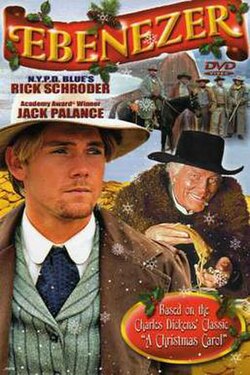
Ebenezer, Starring Jack Palance: Review by William Mortensen Vaughan


 TitleEbenezer

Adaptation(Starring Jack Palance  as  Ebenezer Scrooge

Dates and Places of Earliest Release:  
TUE, 13 OCT 1998
 
My Rating*** (Offensive favorite)

Format Reviewed
live-action film, on DVD
 
Runtime:  1 hour 29 minutes
 
Availability:  
As of November 8, 2021, copies of this film, on DVD, are available, online, for approximately $15 U.S. Dollars.

Is this adaptation reverent? 
Yes, this adaptation is reverent; however, it shows Scrooge having dinner at a house of ill repute, cheating at poker, and fist and gun fighting.

Does this adaptation mention "God" or "Christ"?
[T.B.D.]
 
Does this adaptation include the phrase "God bless us...?" 
[T.B.D.]

What does my wife think of
this adaptation?
She thinks it's "unique."

Where and when does this adaptation take place?
Canada when the horse was the primary means of transportation.
 
What language and/or dialects are used?  
Plain English.

How closely does this adaptation follow the original novel, by Charles Dickens?
This adaptation takes place in a Canadian version of the wild, wild west, featuring Jack Palance as Ebenezer Scrooge, perhaps the most evil Scrooge ever portrayed.  Ebenezer is a gun man, who frequents a house of ill repute.

Albert Schultz plays Bob Cratchitt, Scrooge's bar tender, at his saloon.

Daryl Shuttleworth plays Fred, Scrooge's nephew, the local constable, who dresses like an organ-grinding monkey.
           
Ricky Schroder plays a young man named Samuel Benson, who loses his money, ranch, and horse to Scrooge, playing poker and getting into a fist fight with him.  Scrooge beats him at poker, then, when the young man starts a fight with Scrooge, after losing all of his money and the deed to all of his land to him, Scrooge beats him up with his bare hands, and takes his horse as payment for the damage done to his saloon during the fight.

I'm not sure which character this young man is supposed to correspond to, in the novel.  He is of no relation to Scrooge or Cratchitt.  He is the fiance of Jacob Marlowe's daughter, Erica Marlowe, played by Amy Locane.  Jacob, played by Richard Halliday, is Scrooge's deceased partner, surnamed Marlowe instead of Marley.

When Jacob dies, he leaves his saloon to Erica, but Scrooge keeps it for himself, and gets Erica a job as a cleaning lady in Martha's house of ill repute.  The Martha in this version, played by Darcy Dunlop, is the proprietor at the house of ill repute, instead of Bob Cratchitt's eldest daughter.

Bob has two boys and a girl, but nothing seems to be wrong with any of them.

Samuel Benson is the youngster with the health problem:  bad eyesight.  Due to his poor eyesight, he misses when he shoots at Scrooge in a gun fight, but, by then, Scrooge has been visited by the Ghosts of Christmas Past, Present, and Future, and not only spares the boy's life, but admits he cheated at poker, and gives him back his property, and promises to buy him some eyeglasses.  He also apologizes to his fiancee, Erica, and gives her the saloon which her father had intended for her to have when he died.

In this version, Scrooge got married, but his wife left him for a Royal Canadian Mountie (Richard Comar), who appears as the Ghost of Christmas Present.  A squaw (Michelle Thrush) serves as the Ghost of Christmas Past, and a cloaked phantom (Morris Chapdelaine) the Ghost of Christmas Yet to Come.

Is this adaptation a prequel or a sequel?  
No.

Is this adaptation supernatural? 
Yes, this film features ghosts and time travel.

Is this adaptation "framed"?  
No.

Is this adaptation a musical?  
No.
 
What songs and/or dances are included?  
Music by Bruce Leitl. At least two musical numbers are included.  Scrooge throws Cratchitt's boots at carolers outside his saloon, and sings with his fellow entertainers and the audience during the grand finale.  For the grand finale, Scrooge appears on horseback at the town Christmas pageant, in the role of Father Christmas, and the children and their parents join him in singing an unusual carol.

How attractive and effective is the visual art?  
This adaptation was filmed on a ranch in Canada, and captures the feel of a typical Western movie, with open spaces, horses, and six-shooters.  While playing poker, the players don't even bother with chips, but use cash, and the bartering system (bags of gold and deeds to land).

How creative and intense are the transitions, especially when "the Scrooge" is taken from one time and/or place to another?
The special effects used during the transitions are acceptable.
 
What aerial and/or nap-of-the-earth footage is included?  
N/A  
 
What use is made of background extras?  
Adequate use is made of background extras.

What is the most remarkable thing about this adaptation? 
As I mention above, Jack Palance's Ebenezer is perhaps the most evil version of Scrooge ever portrayed.  Although Scrooge threatens a child with a ruler in the original version, there is no indication he ever physically assaulted anyone.  In this version's future, Scrooge shoots a young man dead during a duel, over the poker game in which he cheated - not to mention beating the boy up with his bare hands, before receiving his ghostly visitations.  Also, while the original version of Scrooge was unfamiliar with the red light district in London, this Scrooge frequented a house of ill repute on a regular basis.
 

What bonus material is included on the tape or DVD? 
No extras are available on the DVD.  My DVD copy has no extras; I just press [Enter] on my DVD player's remote control to play the movie from the splash screen.

A Christmas Carol, Starring Vincent Fegan: Review by William Mortensen Vaughan


 TitleA Christmas Carol

AdaptationStarring Vincent Fegan as  Ebenezer Scrooge

Dates and Places of Earliest Release:  
SUN, 1 JAN 2012
 
My Rating** (Substandard)

Format Reviewed
live-action film, on DVD
 
Runtime:  1 hour, 22 minutes
 
Availability:  
As of November 8, 2021, copies of this film, on DVD/VHS, are available, online, for approximately $15 U.S. Dollars.

Is this adaptation reverent? 
Yes, it's reverent, but it's also creepy!

Does this adaptation mention "God" or "Christ"?
[T.B.D.]
 
Does this adaptation include the phrase "God bless us...?" 
[T.B.D.]

What does my wife think of
this adaptation?
She doesn't like it.  She thinks it's weird and creepy.  She doesn't like the lack of background extras.

Where and when does this adaptation take place?
Out in "the country," sometime after the invention of power lines.
 
What language and/or dialects are used?  
Irish English.

How closely does this adaptation follow the original novel, by Charles Dickens?
This adaptation follows the original novel fairly well, but it is the epitome of why film producers should use background extras.  Although it follows the original story fairly well, it sorely lacks background characters.  It seems to have been shot in the country, rather than in a city; none of the scenes resemble a city such as London, where the original story took place.  There are no passers-by, no shoppers, no boys sliding on the ice, no workers warming themselves by a fire in the streets...  Fezziwig's ball is not a ball; it's a toast among only three people:  Mr. Fezziwig, Ebenezer Scrooge, and Dick Wilkins.  Fred's party isn't a party; it's Fred and his wife - just the two of them.  The scene with Belle and her husband does not even include her daughter, let alone any children - just her and her husband.  Bob is missing three of his six children.  The mother who owed Scrooge money and is glad about his death is missing her husband.  Old Joe attends only the laundress and the charwoman, and not the undertaker's man.

There are only two businessmen at the Exchange, commenting on Scrooge's death, instead of the three or four whom Dickens mentions in his novel.  (Whether or not there are three, or four, is open to interpretation, based on the original novel, but there are at least three:  one "fat man with a monstrous chin," "another," and "a third."  Dickens also makes mention of a "red-faced gentleman with a pendulous excrescence on the end of his nose," but this may or not may have be the man he refers to as "another.")  There are no other people at the Exchange, in this adaptation, which Dickens describes as a busy place, with "merchants" who "hurried up and down" and "conversed in groups."  My wife thinks the two men at the Exchange in this adaptation are the same two men who went to Scrooge's counting house to ask for a donation.

Although one of the women takes Scrooge's bed curtains to old Joe, and Scrooge wakes up on Christmas morning to exclaim that his curtains are still there, he is shown on a bed which is not a four-poster bed, and has no place to put bed curtains.  The scene is shot toward a curtained window, as if to imply that the bedroom window curtains are the bed curtains in question.

Several shots of female ghosts are included, for no apparent reason.  Perhaps the director owed these women a favor.

Is this adaptation a prequel or a sequel?  
No.

Is this adaptation supernatural? 
Yes.  Not only is this version supernatural, it seems more like one of Maria Olsen's low budget horror films than A Christmas Carol.  The music is dreadful, sometimes drowning out the dialogue.  The lighting and over-exposure, mixed with art and double or more expsosures, and the lack of background extras, and the solitary settings, as well as the female Ghost of Christmas Past's masculine, telepathic voice, all added to the creepiness of this film.

Is this adaptation "framed"?  
Yes, this adaptation is framed by Charles Dickens, played by Laurence Foster, reading the story out loud.

Is this adaptation a musical?  
No.
 
What songs and/or dances are included?  
Music by Michael Richard Plowman. If there are any musical numbers in this film, they aren't memorable enough to mention.

How attractive and effective is the visual art?  
The art in this film is very unattractive, especially the Phantom's hand, which seems to be covered by melting wax or acid.

How creative and intense are the transitions, especially when "the Scrooge" is taken from one time and/or place to another?
The transitions are inadequate.  They mostly consist of double or more exposure.
 
What aerial and/or nap-of-the-earth footage is included?  
N/A 
 
What use is made of background extras?  
Inadequate use is made of background extras.

What is the most remarkable thing about this adaptation? 
The most remarkable part of this whole film is the performance/monologue of Neill Fleming, in the role of Bob Cratchit, grieving for the loss of Tiny Tim.  This is the most heart-wrenching show of grief on the part of any Bob Cratchit for any Tiny Tim which I have ever seen!
 

What bonus material is included on the tape or DVD? 
This DVD allows chapter selection.  It also includes trailers, one of which is for an Irish, ghost hunting documentary.

A Christmas Carol, Starring Anthony D.P. Mann: Review by William Mortensen Vaughan


 TitleA Christmas Carol

Adaptation(Starring as Ebenezer Scrooge

Dates and Places of Earliest Release:  
FRI, 20 NOV 2015 U.S.A.
 
My Rating**(Substandard)

Format Reviewed
live-action film, on DVD
 
Runtime:  59 minutes
 
Availability:  
As of November 8, 2021, copies of this film, on DVD, are available, online, for approximately $15 U.S. Dollars.

Is this adaptation reverent? 
Yes.

Does this adaptation mention "God" or "Christ"?
T.B.D.
 
Does this adaptation include the phrase "God bless us...?" 
T.B.D.

What does my wife think of
this adaptation?
She thinks that the Director, Anthony D. P. Mann, looks too young and fat to play Scrooge.  She also thinks it's perhaps the worst musical she's ever seen.  Furthermore, she dislikes the way some of the footage is shot up the actors' noses.

Where and when does this adaptation take place?
Victorian England.
 
What language and/or dialects are used?  
British English.

How closely does this adaptation follow the original novel, by Charles Dickens?
This adaptation follows the original novel fairly well.  There are some modifications to the original story.  For example, the scene in which Scrooge's door knocker resembles Marley's face, is missing.  Also, Scrooge, played by Anthony D.P. Mann, doesn't go home from work on Christmas Eve; instead, he stays at his office.  He sings a song to a portrait of his partner, Marley, played by Terry Wade.  Later, he notices that Marley is missing from the portrait, and suddenly discovers that Marley's ghost is seated in his office.

The Ghost of Christmas Yet to Come (Pamela Prendergast) is a tall woman dressed in black, like a widow at a funeral, showing her face, speaking, and singing!  The Ghost of Christmas Present (Andrea Hiltz) is a fat woman.  The Ghost of Christmas Past (Sherri Paterson) is a blonde woman.)

Is this adaptation a prequel or a sequel?  
No.

Is this adaptation supernatural? 
Yes, this film features ghosts and time travel.

Is this adaptation "framed"?  
Yes, by a narrator, Charles Dickens, played by Colin Baker.

Is this adaptation a musical?  
Yes.
 
What songs and/or dances are included?  
Various original songs are included.

How attractive and effective is the visual art?  
The period costumes look well made and believable; the architecture and sets are adequate, but unimpressive.

How creative and intense are the transitions, especially when "the Scrooge" is taken from one time and/or place to another?
The transitions are acceptable.
 
What aerial and/or nap-of-the-earth footage is included?  
N/A 
 
What use is made of background extras?  
Little use, if any, is made of background extras.

What is the most remarkable thing about this adaptation? 
I found the original songs very moving and/or entertaining.
 

What bonus material is included on the tape or DVD? 
The DVD includes a behind the scenes featurette, starring Colin Baker.

Friday, February 19, 2021

A Christmas Carol (1984), Starring George C. Scott: Review by William Mortensen Vaughan

TitleA Christmas Carol

AdaptationStarring George C. Scott as "the Scrooge"

Dates and Places of Earliest Release:  
FRI, 23 NOV 1984, U.K.
MON, 17 DEC 1984, U.S.A.
 
My Rating****

Format Reviewed
live-action, feature-length film, on DVD
 
Runtime:  100 minutes
 
Availability:  
As of February 19, 2021, copies of this film, on DVD, are available, online, for approximately $10 U.S. Dollars.

Is this adaptation reverent? 
Yes, this adaptation is reverent, starting with a rendition of the hymn "On Christmas Night All Angels Sing." 

Does this adaptation mention "God" or "Christ"?
Yes. (See above/below.)
 
Does this adaptation include the phrase "God bless us...?" 
Yes, Tim Cratchit says, "God bless us, everyone!"

What does my wife think of
this adaptation?
She
likes it.

Where and when does this adaptation take place?
Victorian England
 
What language and/or dialects are used?  
English.

How closely does this adaptation follow the original novel, by Charles Dickens?
This adaptation follows the original novel fairly well. It begins with a narrator (Roger Rees) stating that Marley (Frank Finlay) is dead.  Fred (also played by Roger Rees) visits Scrooge in his office on Christmas Eve.  The portly gentlemen seeking a donation do not.  Scrooge leaves Bob Cratchit (David Warner) working in his office, while he goes to the Exchange.  En route, he discovers Tiny Tim Cratchit (Anthony Walters) waiting for his father.

At the exchange, in a scene not included in the original novel, Scrooge sells his corn to some businessmen.


After closing the corn deal, Misters Poole and Hacking (Michael Gough and John Quarmby, respectively) introduce themselves to Mr. Scrooge, seeking a donation.

Bob closes shop without Scrooge, and takes Tiny Tim to Cornhill to watch the other boys play in the snow and slide on the ice.

Meanwhile, Scrooge returns home, where he sees Marley's face on his door knocker. Jacob Marley appears, but does not show Scrooge the other ghosts, although Scrooge hears them as Marley departs through his window.

The Ghost of Christmas Past (Angela Pleasance) appears, and takes Ebenezer back to one of his lonely Christmases at a boarding school, where old Scrooge tells the Ghost that his father held a grudge against him because his wife (Scrooge's mother) died giving birth to him.

Then Fan (Joanne Whalley) appears to Scrooge after he has become a young man (Mark Strickson), and takes Scrooge outside the school, where their father (Nigel Davenport) is waiting for them, and where he informs Scrooge that he will begin working for Mr. Fezziwig (Timothy Bateson) as an apprentice three days later.

As their carriage departs, old Scrooge and the Ghost remain, discussing Fan and her son, whom Scrooge identifies as Fred Holywell, although his surname was never given in the original novel.

Then the Ghost takes Scrooge to Mr. Fezziwig's place of business, where his young self and Dick Wilkins (Spencer Banks) celebrate Christmas with their old boss, his wife (Pat Rose) and their three daughters, their suitors, and Belle (Lucy Gutteridge).

Then the Ghost shows Ebenezer the day Belle broke off their engagement to be married, and another day, when she is playing outside in the snow with her children as her husband (Peter Settelen) approaches, and informs her that he saw Ebenezer, whose partner was about to die.

Then Scrooge meets the Ghost of Christmas Present (Edward Woodard) who takes him into the streets on Christmas Day, and to the home of Bob Cratchit, where Bob informs his son, Peter (Kieran Hughes) that Fred has offered him (Peter) a job as an apprentice for three Shillings and six Pence a week.

Then the Ghost takes Scrooge to his nephew's Christmas Party, where one of the guests mocks him.

Afterward, the Ghost takes Scrooge to the streets, where he hears a homeless family discussing their limited options.  

The Ghost also shows Scrooge the wretched children under his robe.

Then the Ghost leaves Scrooge in the street, cold and alone in the dark, in a place unfamiliar to him, and the Ghost of Christmas Yet to Come appears to him.

First, this Ghost shows him the Exchange, where three businessmen discuss his death.

Secondly, the Ghost takes him into his own home, where his corpse apparently lies under a sheet.

Thirdly, the Ghost takes him to old Joe (Peter Woodthorpe's) pawn shop, where's Mrs. Dilber (Liz Smith) sells Scrooge's belongings.

Finally, the Ghost takes Scrooge to his tombstone.

Back in his room, Scrooge discovers it's Christmas Day.  After having a boy fetch the poulterer, Scrooge takes a walk, dropping money in the can of some carolers, and pledging a donation to the portly gentlemen whom he happens to pass on the street.

Another scene shows the poulterer delivering the prize turkey to Bob Cratchit's house, where he explains that it was paid for by an anonymous benefactor.  The poulterer doesn't take a cab; he drives his own carriage. 

Finally, Scrooge visits his nephew for Christmas Dinner.

The next morning, he waits for Bob to arrive late, only to double his salary, and promise to help him ensure that Tim's health would improve.
 
Is this adaptation a prequel or a sequel?  No.


Is this adaptation supernatural? 
Yes, this film features ghosts and time travel.

Is this adaptation "framed"?
  No. 

Is this adaptation a musical?  No.
 
What songs and/or dances are included?  
Music by Nick Bicât... In addition to "On Christmas Night All Christians Sing," carolers sing "I Saw Three Ships," as well as "Peace on Earth/God Bless Us Everyone," which was apparently written specifically for this adaptation.

How attractive and effective is the visual art?  
The sets, wardrobe, and architecture are excellent.

How creative and intense are the transitions, especially when "the Scrooge" is taken from one time and/or place to another?
The transitions are adequate.  The Ghost of Christmas Past shows scenes from the past in the reflection of her cap.  The Ghost of Christmas Present shows scenes in the flames of his torch.  The Ghost of Christmas Yet to Come changes scenes with bolts of lightning and claps of thunder.
 
What aerial and/or nap-of-the-earth footage is included?  
T.B.D.
 
What use is made of background extras?  
(Give specific examples of scenes with adequate or inadequate numbers of background extras.)

What is the most remarkable thing about this adaptation? 
The most remarkable thing about this adaptation is, perhaps, the song "Peace on Earth/God Bless Us Everyone," which is played repeatedly throughout the film.
 
Of course, it is also remarkable that George C. Scott stars in this adaptation, but this is part of why it doesn't "work" for me; he will always be General George S. Patton to me.
 
What bonus material is included on the tape or DVD? 
T.B.D.